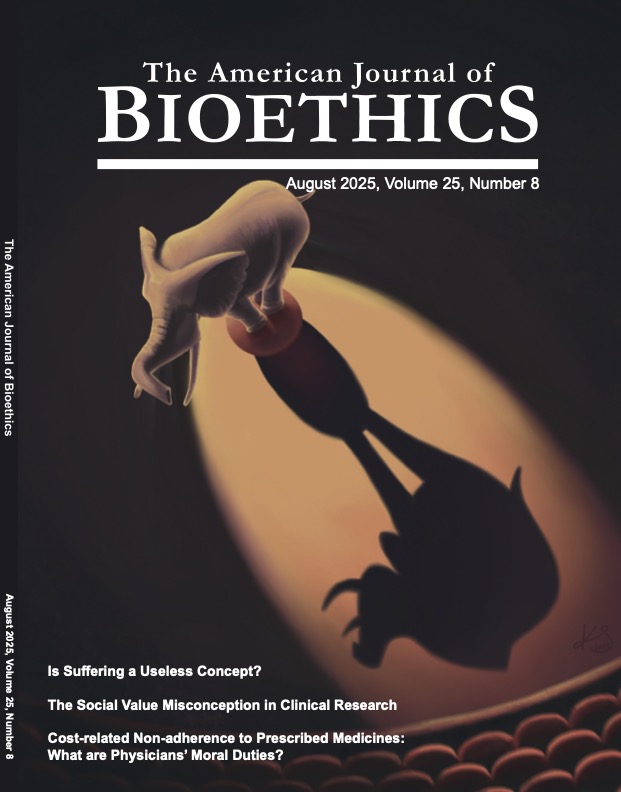
This editorial appears in the August 2025 issue of the American Journal of Bioethics
Echoing Ruth Macklin’s classic essay which challenged the assumption that dignity is a useful concept for bioethics, Nelson et al. offer a provocation regarding the concept of suffering. Is suffering useful? Like Macklin, Nelson et al. claim that concepts taken to be self-evident may be less straight-forwardly applicable in medical ethics, practice, and policy than we assume.
Nelson et al. argue that different theoretical accounts of suffering may give rise to alternative interpretations and thereby cloud communication among patients, families, and clinicians. Using four case studies, and riffing on the work of Brent Kious, the authors identify three vying theoretical frameworks of suffering: “sensation-based,” “flourishing-based,” and “value-based” frameworks. Their exploration highlights the tension among these frameworks’ core structures and reveals how suffering can be understood in conflicting ways.
Nelson et al.’s essay is excellent. It is also perceptive. We echo Nelson et al.’s call for more careful attention to the theoretical underpinnings of suffering frameworks, as well as to how the language of suffering may be used imprecisely, in some cases in ways that bias or exploit patients and families. In addition, like the authors, we question if one unifying theory of suffering can capture the complexity of this concept.
Nevertheless, we will suggest that an expanded version of a flourishing-based view (FBV) of suffering comes closest to fulfilling this goal. This is because a FBV allows for an objective depiction of suffering that is neglected by sensation-based and value-based accounts. Paradoxically, it also provides greater order, nuance and clarity to the lived experience of suffering. While FBVs will require a worked-out taxonomy of suffering to specify the type of suffering present, we believe they provide the scaffolding for a more robust conceptual understanding of suffering. This can be observed when attempting to characterize the suffering of people with disabilities, in particular.
The Priority of the Subjective in Accounts of Suffering
We begin by acknowledging that the distinction between objective and subjective views of reality is historically contingent, and in some ways artificial and unhelpful. The subjective experiences of persons are always necessarily embodied, situated in a particular time and place, and interdigitated with the physical world. You risk privileging the subjective at the expense of the objective, or vice versa, if you neglect this ongoing subjective-objective dialectic.
Most classic accounts of suffering in bioethics favor subjectivity over objectivity. We take both the sensation-based and value-based accounts to be constitutively subjective, in that they rely on personal sentience and rationalist-individualist future-oriented perspectives as the key determinants of suffering, respectively. As the authors note, these accounts risk both overdetermining suffering (if the individual mistakenly takes herself to be suffering), and neglecting suffering when an individual fails to recognize it.
Flourishing as Attending to Both Subjective and Objective Elements of Suffering
In contrast, the authors correctly note that FBVs take seriously the objective element of suffering, evident by the claim that we can suffer even if we are unaware that we are suffering (as noted in the authors’ example of one addicted to drugs, or in Tate’s example of a desensitized child in an abusive sexual relationship normalized by their perpetrator.) FBVs then, allow us to recognize suffering that may not be felt or subjectively experienced (at least not all of the time).
Yet FBVs do not just include objective notions of suffering. They also acknowledge the importance of integrating subjective experience into a flourishing life. For human beings, a full description of flourishing includes an account of subjective experience (in contrast to the flourishing of plants). A central feature of flourishing-based accounts, as the authors rightly note, is that they rely on some normative anthropology—some particular understanding of persons pursuing and enjoying the good. While specific accounts such as classic Aristotelian, Thomistic, neo-Aristotelian, or even Marxist vary in their view of the flourishing person, they all put forward an understanding of the human person in community, seeking to develop virtues in pursuit of some end. Traditionally, these accounts have assumed that flourishing persons integrate physical health, emotional stability, intellectual development, vocational practice, and communal/relational involvement. To flourish involves all these elements to varying degrees, depending on a person’s given capacities and constraints. To flourish in these objective, homo sapien-specific domains we humans must integrate subjective thoughts, desires, emotions, and experiences that support the activities of flourishing. In a flourishing-based framework, suffering comes from being unable to achieve one or more of these human capacities or goods.
Failing to achieve the goods of life, then, extends beyond objectively measurable problems like broken bones or respiratory failure requiring mechanical ventilation. Flourishing can be blunted by subjective experiences of pain or discomfort—characteristic of a sensation-based account—or the perceived failure to actualize one’s values—characteristic of a value-based account—to the degree that these subjective experiences constitute one’s inability to achieve one’s own good. In this way, FBVs can include elements of both sensation and value-based accounts of suffering but are not wholly reducible to the subjective perspective these accounts presume.
Resiliency and Creative Re-casting of Subjective Suffering
Because a FBV of suffering recognizes both objective and subjective dimensions of suffering, it may be more sensitive than either a sensation-based or value-based account. Yet it also may prove more specific, as a flourishing-based account does not reduce suffering to mere subjective pain or frustration of one’s putative values. Rather, a FBV allows for a creative integration and re-interpretation of the sensation-based or value-based causes of suffering.
For example, whereas a sensation-based account of suffering might equate chronic refractory pain with suffering, a flourishing-based account might understand this pain as an opportunity to strengthen one’s character or as an opportunity for growth through enduring adversity (it follows that there is also something inherently hopeful about FBVs). Similarly, a values-based account might label a professor who sustains a traumatic brain injury (TBI) with subsequent cognitive deficits as necessarily suffering, whereas a FBV might recognize such a disability as an opportunity to deepen one’s faith commitments or relationships as a form of fulfillment rather than suffering. In this way, FBVs do not conflate suffering with the presence of discomfort or adversity, and allow for more specific use of the term, for when one’s flourishing is truly disrupted.
Suffering and Disability
We can see the strength of a FBV when we consider the question of suffering for those with physical and intellectual disabilities. The target article authors rightly point out that some FBVs may risk mis-characterizing those with disabilities as suffering because they are perceived as falling short of some flourishing standard which a priori excludes those with disabilities. A long history in Western philosophy ranging from Aristotle to utilitarian philosophers including Jeremy Bentham and Peter Singer view life with disabilities as incompatible with flourishing. This traditional interpretation of disability as pathology can dull our appreciation of the many ways people live good lives with significant medical conditions or disabilities that many nondisabled people consider intolerable. Of particular ethical concern are life-ending healthcare practices such as medical aid in dying or selective abortion that apply rationales based on the prevention of suffering. To a large degree, such views rest on the anthropological presumption initiated by Aristotle that excludes certain persons from fully flourishing (including women, slaves, and those with disabilities).
Acknowledging this problem, we contend that a more capacious and textured view of flourishing that does not conflate disability with deficiency or suffering offers a way to identify the flourishing (and by extension, suffering) of those with disabilities more accurately. Such inclusive versions of human flourishing go beyond a focus on pain, capability, longevity, or normalcy and are instead attentive to how one actualizes their potential for good, given their own particular bodily or intellectual constraints. Such frameworks often involve the appraisals of people with disabilities as well as communities and persons who know people with disabilities well, and in this way incorporate both subjective and objective perspectives to consider whether people living with disabilities and illnesses might truly be suffering.
These inclusive flourishing-based accounts offer alternatives to the potential shortcomings of both value-based and sensation-based accounts of suffering vis-à-vis those with disabilities. Value-based accounts risk both potentially disqualifying from suffering those who cannot articulate a vision of a good life (for instance, a person with significant intellectual disability), and reducing the lives of people with disabilities to inherent suffering if they are unable to participate in the activities commonly valued by others around them. Similarly, sensation-based accounts risk categorically ascribing suffering to those with disabilities who may appear uncomfortable and cannot voice otherwise, thereby collapsing the gap between 3rd party perceived discomfort and suffering. Inclusive flourishing-based accounts, in contrast, contribute communal perspectives to counter stereotypes and de-valuation that prevent people from recognizing flourishing in the lives of people with disabilities, while also recognizing that those with disabilities can suffer in ways that frustrate their own, particular flourishing.
Flourishing and Its Limits: Acknowledging A Taxonomy of Suffering
While flourishing-based accounts of suffering may prove more sensitive and specific than sensation-based and value-based accounts, particularly in the realm of disability, we acknowledge that the complexity of suffering as explored by both Nelson et al. and our commentary requires a more precise taxonomy of suffering that elaborates its physical, social, cultural, existential, and psycho-emotional forms. Nelson et al. begin that process with their “Box 2” catalog.
To address the rhetorical provocation in Nelson et al.’s title as to whether suffering is a “useless concept,” we respond with a charge: we must craft a taxonomy of suffering that tracks the temporal and spatial particularities of lived human existence. We suspect that if a person’s suffering is understood as a persistent and systematic constraint on flourishing, considering the type of suffering (physical vs. existential vs spiritual etc.) one undergoes (which will likely parallel the type of flourishing that is being constrained) will lead to not only a better understanding of suffering but also a more appropriate, and less ethically vexed, mode of address.
For example, a taxonomy might clarify that a patient with early amyotrophic lateral sclerosis (ALS) who maintains strong relationships and community may suffer physically and existentially but not socially. Such a taxonomy in this situation would correctly identify suffering which frustrates flourishing, but in a precise way that does not conflate disability with suffering tout court. While it is beyond the scope of this commentary to provide such a taxonomy, we reckon that a taxonomy-including FBV can provide a more realistic and complete characterization of suffering.
Conclusion
We believe Nelson et al. offer an important analysis of the variety of conceptual understandings of suffering, an analysis which will advance clinical care and medical-ethical decision-making. While it may be true that no single theory can account for the full complexity of suffering, we believe that FBVs allow for a more sensitive and specific understanding of suffering than sensation or value-based accounts. These conceptual distinctions are particularly important to keep in mind if one is to avoid the common false equivalence of disability and suffering. Ultimately, we agree with the call from Nelson et al. for further attention to the specification of different types of suffering—a taxonomy within a broader flourishing-based account. We see this as the task ahead.