Used by one-third of US adults and the majority of teens, the social media platform TikTok, has emerged as a hotbed for social and political commentary. Viral TikTok content regularly amasses millions of views and hundreds of thousands of comments. The platform has become the most popular app in the last four years, creating some of the wealthiest content creators in the world. It also has immense political and social influence, being cited as a major contributor to President Trump’s second-term election win. It cannot be underscored the influence TikTok has on swaying perspectives pertaining to culture, society, and politics. One reason the platform remains incredibly influential is its powerful algorithm. Several studies have found that social media algorithms, particularly TikTok’s, tend to promote controversial content that evokes anger and moral outrage. While TikTok users may be constantly provoked by emotionally charged posts, it’s unclear to what extent their moral values may be influenced when engaging with the app.
The term “social media manipulation” was coined to describe how the features of social media algorithms (e.g., hypernudging and microtargeting) and the uncontrolled proliferation of misinformation bots influence users online and offline. Social media companies have been the target of speculation from politicians, journalists, and the public as cultivators of misinformation and radicalization. Senators from both sides of the aisle have called out divisive content about social media’s detrimental impact on young people. These arguments are not new. Websites like 4chan have been publicly discussed as hotbeds for far-right radicalization that encourage dangerous behaviors like doxxing, swatting, and in some cases, mass violence. Taken together, social media manipulation and the ability of (even a few) bad actors to gain significant exposure, we see that the average user’s social and political reality can be easily distorted. Further, these apps can even have the ability to influence what values are embodied and expressed through the development of new social norms.
So we ask, if there’s evidence that social media influences and manipulates user behavior, then is it possible that social media also influences users’ moral sensibilities?
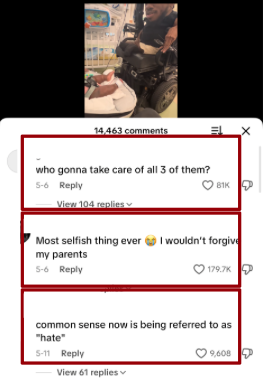
Using a case study, we hypothesize that the tendency for social media algorithms to generate moral outrage is re-integrating and normalizing disavowed value systems, like eugenics. For example, Dej and Antwon are Black disability influencers with Osteogenesis Imperfecta (OI), who collectively have over one million TikTok followers. As influencers, videos of their lives are routinely the target of discussions on lifestyle choices of people with disabilities. A (now deleted video) announcing the birth of their daughter, who was also born with OI, led to severe public outrage (See Figure 1). Responses from other creators and commenters started with concerns for the child and evolved into a debate on whether disabled people should have children.
On TikTok consensus is driven by “likes,” where the most liked comments rise to the top. For instance, the top comment with 180 thousand likes, called Dej and Antwon’s actions, “[The] Most selfish thing ever😭 I wouldn’t forgive my parents.” This is particularly of concern, because it characterizes Dej and Antwon as bad parents for having a child with a disability. This discourse reflects a pervasive eugenics practice of publicly evaluating disabled people’s reproductive choices and applying moral judgment. While it is unclear what values and beliefs people hold outside of the comment section, the app and comment section alike have created an environment where eugenics and other disavowed value systems (i.e. racism) are tolerated and engaged.
As such, we posit that one of the largest places everyday people gather to debate morality, ethics, and morally acceptable social norms, is TikTok. As a field, bioethicists should interrogate the possibility of social media changing moral realities. The discussions occurring online have larger implications for society, but determining their impact on moral sensibilities is more challenging to empirically capture compared to shopping trends or voting behavior.
Despite the need for bioethicists to engage with online content, it is unclear how we are supposed to navigate the ethically complex conversations or how to rigorously study its users. Should we engage in social media, as influencers or fact checkers? How should we invest in empirical bioethics research on TikTok and other social media apps? How should bioethicists intervene in what seems to be a mass social and moral backsliding event? We invite bioethicists to think deeply about how to respond.
Social media platforms are shaping and reshaping perspectives on, attitudes towards experts, expectations of public institutions, political beliefs, and possibly moral values, without much engagement from bioethicists. As a complex AI age is on the precipice, public health is dismantled, and our government officials push mis- and disinformation, we must keep our fingers on the pulse of the commentary that is happening on TikTok. If not, bioethicists risk ceding influential public discourse to voices that may undermine ethical reasoning, public trust, and evidence-based decision-making.
Figure 1
Taylor Montgomery, MPH is a doctoral student at Johns Hopkins University Berman Institute of Bioethics
Odia Kane, PhD, MPH, is a post-doctoral fellow at the Johns Hopkins University Berman Institute of Bioethics and Institute of Assured Autonomy