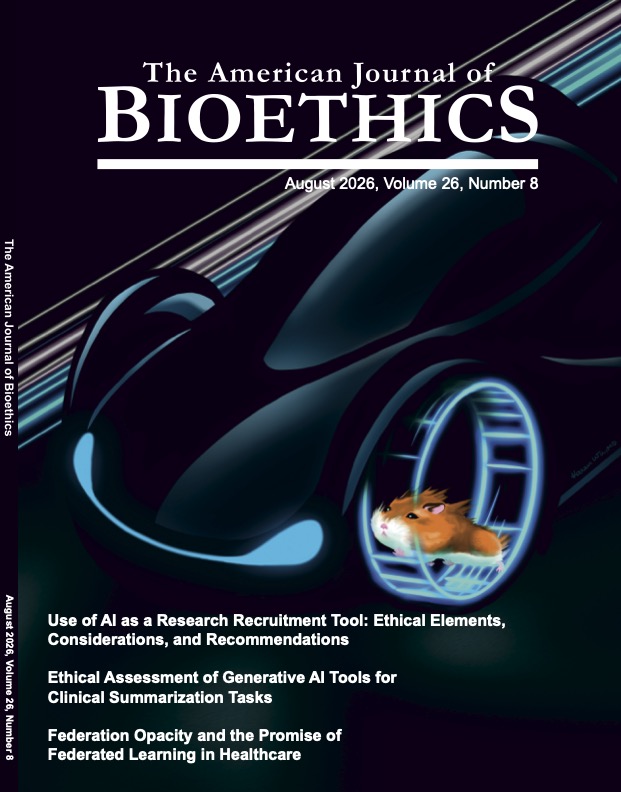
This editorial appears in the August 2026 Issue of the American Journal of Bioethics
Artificial intelligence (AI) agents are being used to support a range of healthcare activities, offloading tasks that have traditionally been performed by human workers. These tools have a variety of use cases in healthcare and currently are being used to support medical decision-making and diagnosis, scientific discovery, clinical documentation, appointment scheduling, and patient triage. Multiple societal and institutional pressures have highlighted the importance of reducing administrative costs in healthcare, making AI agents an attractive solution for generating efficiencies. While there are mixed opinions on whether these tools will deliver on their promises related to efficiency gains and cost reductions, their potential has generated major investments in applications of healthcare-related AI.
This issue of AJOB highlights several contexts in which AI agents are likely to play a significant role in healthcare. Char et al. focus on AI-enabled clinical documentation, an area where AI agents may support clinical note writing and other documentation-related tasks with greater efficiency. Rentzepis et al. highlight other applications of AI in clinical research, where AI agents may support subject recruitment, clinical trial design, data analysis, and study management. It is encouraging to see bioethicists examining these and other “early-use cases” involving AI agents, adding to an ever-growing literature exploring ethical dimensions of healthcare AI.
We anticipate that this trend will continue as the number of AI applications in healthcare expands. The work of bioethicists will be crucial for understanding the moral complexities of these technologies, particularly in contexts where AI tools are tasked with autonomously performing the work of healthcare professionals.
What is less clear is the extent to which AI agents will impact the day-to-day work of bioethicists. As health systems look for ways to extend resources and create workflow efficiencies it is likely that pressures to expand the use of AI agents in bioethics-related work will result. We suggest that bioethicists ought to anticipate this possibility and be proactive in considering how AI agents may redefine their work. In this brief editorial, we consider several potential applications of AI agents in bioethics, highlighting how these tools might impact activities in clinical ethics, bioethics research, and ethics education.
There are already several opportunities for clinical ethicists to integrate AI agents into their work. For instance, AI agents might be used to extract and summarize information from a patient’s electronic health record or to identify laws, regulations, and institutional policies that may be relevant to an ethics consultation. Similarly, AI agents might be used to support clinical documentation activities done by clinical ethicists, for example, drafting clinical notes based on a family meeting or a complex care discussion. Additionally, conversational agents might be used to gather stakeholder narratives or to clarify patient values.
In addition to these AI tools, emerging agentic AI systems are being developed to support ethical analysis and clinical decision-making. For instance, Dutta Roy has presented a Bioethics Artificial Intelligence Advisory (BAIA) framework in which multiple ethical frameworks are collaboratively applied to cases in clinical ethics. In the future, systems like the BAIA might be used by clinical ethicists to confirm a clinical recommendation, providing a second opinion on their moral reasoning or analysis of a complex case. It is also possible that future AI systems might augment the moral reasoning capabilities of healthcare professionals who have not had formal training in bioethics, which may be particularly beneficial in resource-limited settings where a formal ethics consultation service is not available.
In a very different setting, bioethics researchers might also use AI agents in support of their work. For instance, AI agents have been developed to support literature reviews and synthesis of large datasets. Of note for bioethics researchers, there are emerging agentic AI systems that aim to simulate or automate aspects of qualitative research. For instance, AI systems are being developed to simulate focus-group discussions, which can include pre-defined participant archetypes or personalities. Other AI agents may autonomously conduct qualitative interviews or moderate focus groups. While these are nascent technologies, they could significantly reduce both the cost and time required to conduct qualitative bioethics research.
Lastly, bioethics educators also have a multitude of opportunities to integrate AI agents into their teaching. Tutoring-focused agents might aim to create personalized and adaptive guidance for ethics learners, particularly in contexts where ethics education is completed asynchronously. Other AI agents may support instructor-led simulation activities as a means of discussing complex ethical cases and fostering moral deliberation amongst students.
Beyond serving as support tools for bioethics educators, future agentic AI systems might serve as ethics instructors in a stronger capacity. In a previous volume of AJOB, Rahimzadeh and colleagues called attention to potential uses of generative AI tools in the teaching of bioethics, noting biases in the ethical frameworks reflected in responses. Emerging agentic AI systems may help to address issues of bias in ethics education by incorporating multiple ethical frameworks in their design and prioritizing ethical reflection over conflict resolution. This is not to say that these systems are comparable to instructor-led teaching, but they may offer an alternative approach to some types of ethics education.
Our sense is that in comparison to other healthcare professionals, many of whom are more proactively exploring the use of AI tools in their work, bioethicists have tended to be a bit more skeptical about the potential promise of AI agents. As a result, bioethicists may want to consider the experiences of professionals in these other fields, where early AI adoption has begun, such as radiology, and consider analogous strategies for the using AI agents in our work.
By highlighting several areas where AI agents may impact the work of bioethics, we aim to call attention to the importance of reflecting on the scope of acceptable and unacceptable uses of these tools in bioethics-related activities. A wide range of AI agents will likely be accessible to bioethicists soon, and it will be incumbent on individual practitioners to decide for themselves which of these tools are appropriate for their work. Whether it be to support a care team in a complex ethics consultation or to enhance the delivery of ethics-related content in a classroom, bioethicists will have many opportunities to use AI agents in their work.
Unfortunately, there are still many uncertainties related to these emerging AI agents. For instance, will a documentation tool capture subtle points of consensus or disagreement in a complex clinical discussion related to goals of care? Will an AI agent perform as well as a trained research analyst in collecting and analyzing qualitative data? Will an educational agent recognize the unique needs of bioethics learners and respond accordingly? By proactively asking such questions, and potentially contributing to the development and evaluation of AI agents, bioethicists can be better prepared for the many changes that lie ahead as healthcare systems deploy new AI tools. In this regard, we suggest that bioethicists should not only examine the ethical complexities of AI agents being deployed in other areas of healthcare but should consider the potential impact of these tools on the work of bioethics itself.
Notes
We use the term “AI agent” to refer to a generative AI system that autonomously executes multi-step tasks with limited human oversight.
Austin M. Stroud, MA & Richard R. Sharp, PhD