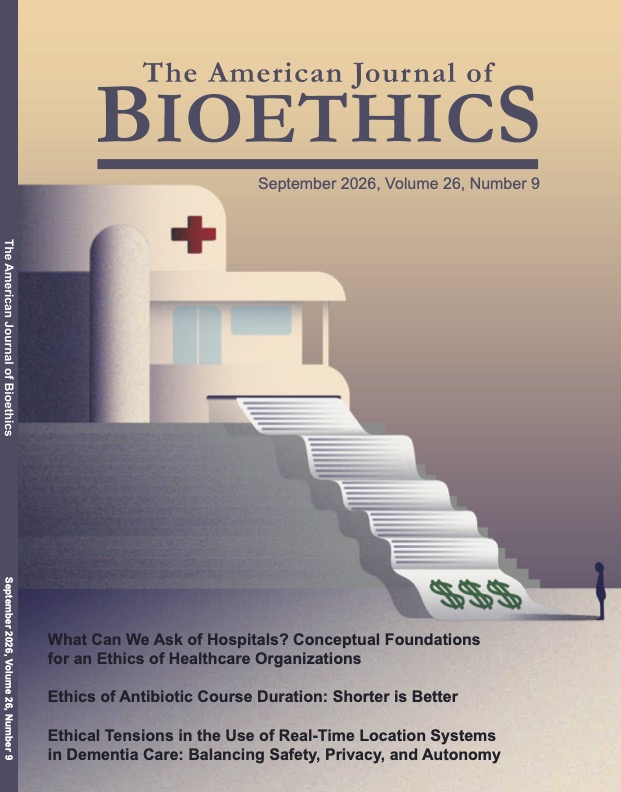
This editorial appears in the September Issue of the American Journal of Bioethics
In Moore et al.’s article, “What Can We Ask of Hospitals? Conceptual Foundations for an Ethics of Healthcare Organizations,” the case is made that health care organizations have an ethical obligation or prima facie duties to their patients over and above the obligations of clinicians and staff. To better understand the role and responsibilities of health care institutions, we believe it is worthwhile looking at the historical context in which hospital-based care arose as part of the US health system.
Before the 1940s, hospitals and health care systems were a true rarity until Congress passed the Hill-Burton Act in 1946 which provided federal funding for the construction and modernization of hospitals and other health facilities. Up until this point, medical care was largely provided by individual physicians rather than large health care systems. This legislation led to the dramatic expansion and creation of hospitals nationwide. The argument made for this support was primarily in terms of the impact of hospitals in improving health to the communities in which hospitals reside. Eventually, this obligation would lead to a commitment for hospitals to provide access to health care at little to no cost to patients. As of 2023, 127 health care facilities across the United States remain obligated to provide care despite the cessation of funding in 1997 (Hill-Burton Free and Reduced-Cost Health Care | HRSA 2023). In 1986, Congress passed the Emergency Medical Treatment and Labor Act (EMTALA) to ensure hospitals offered public access to emergency services and were “required to provide stabilizing treatment for patients with an emergency medical condition” within its capability regardless of an individual’s ability to pay. Law makers recognized the inherent duty of hospitals and health systems to attend to the health and well-being of their communities. As Pope (this issue) argues in his commentary, this is partly why there is even more regulatory oversight of hospitals and health systems than of individual clinicians.
While Moore et al. argue that hospitals and health care organizations have obligations to individual patients, they perpetuate the traditional ethos of medicine as a fundamentally dyadic relationship between clinician and patient. They seem to extend this dyad from individual clinicians to the institution as a whole and analogize the relationship to recognize similar potential for benefit and harms from institutions over and above the harms and benefits caused by individuals, hence treating institutional obligations similarly to those of individual clinicians. But the historical origins of the push to “hospitalize” health care was built on a very different ethos, one grounded in obligations to communities, not merely individuals within that community. In short, the other side of the dyad also needs to be reconfigured if we are to move beyond the patient-clinician relationship.
Examples of this way of thinking about obligations can be seen in debates that academic hospitals have about the potential tradeoffs between providing care (even routine care) in their immediate communities versus taking on more acute, complex or “interesting” patient cases from outside the area. This is a particularly important issue and fraught calculus for academic medical centers (AMCs). The moral and ethical issues present in these debates will be invisible to a focus on harms to individual patients and bioethics has not done enough to address these issues (though hospital ethics committees sometimes are involved in these discussions).
Another example of the need to recognize the moral salience of the community has arisen over drug shortages and expanded access programs for in-demand therapies. When Spinraza was first developed and shown to be effective for slowing or stopping progression of SMA1, but prior to FDA approval, there were expanded access programs set up at a small number of sites where the trials for the drug had taken place. This led to discussions about the degree to which priority ought to be given to patients with established relationships with the institution. Again, this type of moral consideration—the prima facie obligations we have toward existing patients or to patients in the immediate vicinity and how to consider tradeoffs with other relevant values or duties is important work taken up by many hospital ethics committees and by bioethicists. Yet this issue will not be fully captured through a lens that focuses strictly on harms to individuals. This same debate has recurred over considerations around the ethics of allocation of drugs during drug shortages. Relative weighting of existing patients within the health system, geography, equity, and need have all been part of the moral tradeoffs that institutions grapple with–-often with help from their ethics programs. Some institutions have used community engagement as part of a process of ethical decision making for developing policies around allocation.
One final illustration of the need to consider communal duties over and above obligations to individuals can be seen in the literature on the learning health system. Kass and Faden argue that the Learning Health Care System (LHCS) requires three “respect promoting” actions that institutions are obligated to undertake for an ethical justification of the learning health care system. Two of these obligations are communally directed with one having an explicit duty to engage in a process involving community engagement for priority setting within the LHCS and a second duty to the accountability to develop improvements in the care of the community the institution cares for. In short, both obligations are best understood in terms of institutional duties and harms to the community they serve, and focusing solely on harms or benefits to individuals may miss that it is relevant which patients are impacted as well as the process itself.
Unfortunately, hospitals and health systems have often failed to meet their communal obligations. LHCSs often fail in adequately engaging impacted communities in their policy creation and priority setting. Scarce resource allocation policies and processes may fail to adequately include members of affected communities in the planning process. Perhaps most seriously, many AMCs do not provide care for underserved members of their community. Hospitals may have various ways in which they fulfill this obligation-division of labor within a quaternary hospital system taking high acuity patients from around the country while transferring lower acuity patients to an affiliate hospital that serves the hyperlocal community. However, EMTALA still guarantees that no unstable patient will be turned away who requires treatment. While some degree of rationalization of resource allocation is appropriate, it is a moral failing when members of underserved and under-resourced local communities do not feel welcome at AMCs. There are often cultural, social, and geographic obstacles that prevent these patient populations from seeking out or receiving care at AMCs. This rationalized system where under-resourced populations get care at community hospitals and only transfer to a higher acuity level of care at AMCs may systematically fail part of the community in which AMCs reside.
We have experience helping to address all the issues discussed above at our institution. One of the standard requests we make when involved in institutional initiatives surrounding decision making and priority setting is to include community representation. This is undoubtedly a heavy lift, but perhaps knowledge and experience in community engagement should become an essential tool for clinical ethicists engaged in organizational ethics work. We appreciate Moore, et al.’s attempt to move us from a strict dyadic ethos of the patient-clinician relationship to recognizing that institutions themselves can cause harm or benefit to patients and therefore have duties over and above the duties of clinicians. However, we believe they do not go far enough in recognizing that some of the duties and obligations of institutions are not just grounded in harms and benefits to individuals but also to the communities that hospitals were created to care for.elieve; rather, it is rampant elite ableism that is the true epidemic. In fact, one could argue that an ableist classism has animated much of the policy decisions to eliminate vaccine recommendations—tools that in the absence of a universal health care system have greatly benefited marginalized groups. The tools and language of public health would be better applied in preventing and reducing the burden of this narrowmindedness rather than being bastardized to promote harmful, dangerous, and bigoted ideology.
Kate Luenprakansit, MD, HEC-C and David Magnus, PhD