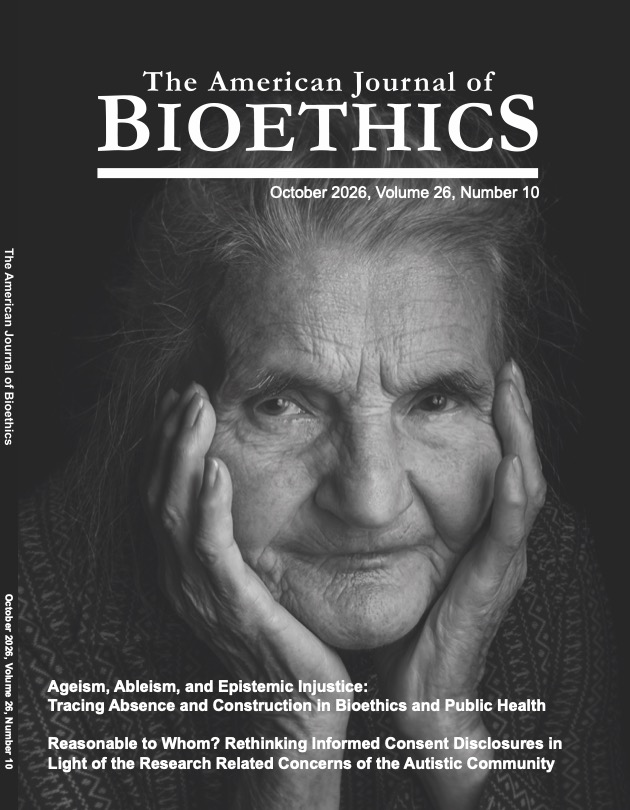
This editorial appears in the October 2026 Issue of the American Journal of Bioethics
In Ageism, Ableism, and Epistemic Injustice: Tracing Absence and Construction in Bioethics and Public Health, Langmann and Goldberg demonstrate how ageism and ableism operate as epistemic forces that shape whose knowledge counts in bioethics and public health. Older adults and people with disabilities are frequently excluded not only from decision-making processes but also from the production and validation of knowledge. Langman and Goldberg introduce two interrelated dynamics; absence (the exclusion of perspectives) and construction (the active reinforcement of hierarchies by institutional norms). They show how these concepts manifest through institutional norms, policy frameworks, and healthcare practices to determine who is recognized as a valid knower and what counts as legitimate knowledge. Their analysis offers a powerful account of epistemic injustice at the intersection of older age and disability.
Building on Langmann and Goldberg’s argument, we contend that the implications of their analysis extend beyond questions of representation and inclusion. To that end, we introduce the concept of epistemic imagination. Whereas epistemic injustice exposes the exclusion or marginalization of persons, perspectives, and forms of knowledge, epistemic imagination refers to the collective capacity to envision alternative, better, ways of understanding aging, disability, care, and dying. From this viewpoint, the task of bioethics is not only to ask whose knowledge counts, but also to examine which futures its conceptual frameworks advance, and which futures they may foreclose.
Our argument draws on the outcomes of a three-day interdisciplinary workshop held at the Brocher Foundation in May 2026. The workshop brought together 20 ethicists, social scientists, clinicians, anthropologists, health policy experts, and patient advocates from around the globe to develop an interdisciplinary perspective on addressing ageism and ableism in policies concerning people nearing the end of life. Through iterative dialogue, critical reflection, and collaborative deliberation, we identified key conceptual challenges and developed recommendations for promoting ethically sound, inclusive, and equitable approaches to connect policies that support aging well with policies that support dying well.
Older Age, Disability, and Dying as Sites of Epistemic Marginalization
The intersection of older age, disability and dying constitutes a revealing site of epistemic marginalization. Modern healthcare systems tend to approach later life through the lenses of risk, decline, care dependency, and functional loss. Older persons living with chronic illness, frailty, cognitive impairment, and increasing care needs often find that their experiences are interpreted through preexisting assumptions about aging rather than on their own terms. Similarly, people with disabilities frequently encounter systems that privilege professional expertise over expertise-by-experience and understand disability primarily through a medical lens. As Langmann and Goldberg and others demonstrate, such dynamics undermine the epistemic standing of those whose lives diverge from dominant norms of health, productivity, and independence.
Our workshop found that the epistemic dynamics at play extend beyond the exclusion of particular knowers or forms of knowledge. Specifically, it revealed a set of mutually reinforcing conceptual reductions that shape contemporary understandings of older age, disability, and dying. First, dominant cultural narratives that circulate in many societies continue to privilege autonomy and self-sufficiency as markers of a life well lived. In contrast, older age is frequently conflated with decline, care dependency and diminishing social value, an ageist assumption that becomes even stronger when older age and disability intersect. When later life is understood predominantly through this lens, its diversity is obscured, while ageism and ableism translate into exclusion, unequal access to services, and the neglect of the needs and priorities of older people with disabilities.
Second, dying itself occupies an epistemically peripheral position within contemporary healthcare and policy discourse. Such discourse commonly reduces death to a biomedical event and frames it as a clinical failure or a problem to be managed, rather than as a foreseeable dimension of finite human existence. As a result, end-of-life care is still predominantly understood in biomedical terms, while its relational, existential, social, and public dimensions remain comparatively neglected.
Third, these conceptual reductions are reinforced by broader systems of social inequality and intersecting forms of bias and discrimination. Socioeconomic disadvantages, insufficient access to care, social isolation, barriers to participation, and the absence of supportive networks shape experiences of aging and dying unequally, placing some individuals and groups at a far greater disadvantage than others. These inequalities also influence whose perspectives are recognized as valid and whose needs are acknowledged. Epistemic injustice at the end of life, therefore, cannot be separated from the structural conditions that produce and sustain social exclusion.
Taken together, these dynamics do more than silence particular voices. They narrow the interpretive and moral horizons through which older age, disability, care, and dying can be understood. The persistence of ageism, ableism and other “isms” including sexism, classism, and racism operate as an interconnected system that shapes whose knowledge is recognized, whose experiences are rendered intelligible, and whose perspectives remain marginalized. They influence not only who can contribute to collective understanding, but also what societies are capable of imagining and valuing as a good life in later life. Certain ways of understanding human flourishing amid human predicaments may become increasingly difficult to conceive.
Critical gerontology has long shown how dominant narratives of “successful” or “healthy” aging, together with ideals of self-sufficiency embedded within aging-in-place policies, narrow the range of lives considered desirable. Aging-in-place policies, for example, are often premised on the involvement of family members, neighbors, friends, and local communities as sources of care, while simultaneously framing it in terms of independence and self-sufficiency. Responsibility for maintaining aging in place is shifted from institutions to individuals, families, and whatever local programs may be available, but the project is still represented as one of independence and self-reliance. This framing reduces aging in place to a binary between maintaining “independent” residence or failing to do so. The association of aging in place with self-sufficiency also obscures the extent to which aging in place is a relational achievement constituted through adequately supported networks of care, infrastructures, and everyday social practices. As a result, care dependence comes to signify the failure of aging in place, while the collective labor required to sustain life at home remains largely invisible. The specific problem here is therefore not the absence of relationality but its instrumental incorporation into an otherwise individualistic framework. Relationships become a means of sustaining independence rather than a recognition of interdependence as a constitutive feature of human life.
Challenging individualistic conceptions of aging well require recognizing that human beings are fundamentally relational and embedded within networks of care, reciprocity, and mutual dependence. Frameworks such as relational autonomy and indigenous knowledge systems offer concrete alternatives of conceptualizing personhood grounded in interdependence and shared responsibility. These perspectives, however, remain peripheral within most healthcare and policy narratives, subordinated to concerns about risk management, efficiency and individual choice.
Beyond Addressing Exclusion: the Importance of Epistemic Imagination
It is precisely in response to this narrow, unsatisfactory prospect of aging that motivates our proposal of epistemic imagination: the capacity to envision alternative conceptual frameworks that recognize aging, care dependence, and mortality; not as deviations from a good life but as ordinary and constitutive dimensions of the human condition. More than a matter of knowledge production, epistemic imagination concerns the social and moral horizons that determine which ways of life become conceivable. Epistemic injustice asks who counts as a knower; epistemic imagination asks what kinds of futures can be imagined. Scholars have suggested that in times of social transformation, the capacity to reimagine established ways of thinking becomes a moral imperative. Demographic aging, increasing care demands, changing family structures, and growing social diversity require forms of imagination that not only envision more caring communities but also reimagine the social and institutional conditions that enable such communities to flourish. From this perspective, epistemic imagination is fundamentally a social and political project. It expands our capacity to imagine societies in which care and dependency are understood as normal and valuable features of human life; care is organized as a collective responsibility rather than a private obligation; and aging, disability, and mortality are recognized not as failures to achieve independence but as constitutive dimensions of the human condition.
Reimagining Aging and Dying in Bioethics
What becomes possible when epistemic imagination is expanded? First, it enables us to rethink our understandings of living and dying well, which are fundamentally entwined. Instead of defining them in terms of independence, autonomy, and functionality, we propose that they be understood through the concepts of relationality, meaningfulness, and belonging. Second, cultivating epistemic imagination encourages a shift from person-centered care alone toward a richer understanding of relational care. Such a shift does not diminish individual autonomy or voice. On the contrary, it recognizes that persons develop and express values within relationships and social and material contexts. The challenge is therefore not to replace autonomy with relationality, but to understand autonomy itself as relational and socially embedded. As such, the disability justice principle of “Nothing About Us Without Us” remains essential, ensuring that the people involved in policy making, including older persons, people with disabilities and their caregivers, can participate meaningfully in decisions that affect their lives.
Third, epistemic imagination opens new possibilities for policy. We argue for moving beyond fragmented and medicalized approaches toward integrated frameworks linking aging, caregiving, palliative care, community participation, housing, and social inclusion. Emerging models such as compassionate communities, community-based care networks and initiatives in intergenerational aging-in-appropriate-places illustrate how alternative arrangements can challenge dominant assumptions about where care belongs and who is responsible for providing it. But, as mentioned above, these approaches require continuous careful attention to inequality and to the risks of transferring responsibilities from public institutions to families and communities without adequate support. Ultimately, expanding epistemic imagination invites societies to shift from managing decline toward creating the conditions in which people can live, age, and die well enough, with whatever measure of comfort, connection, and meaning their circumstances permit. This shift requires not only new policies and practices, but also new narratives capable of recognizing aging, disability, care dependency, and mortality as ordinary and integrated aspects of our shared humanity.
Conclusion
Langmann and Goldberg demonstrate how ageism and ableism produce epistemic injustice by shaping whose knowledge is recognized and whose experiences remain invisible. We assert that their analysis points to a further challenge. Ageism and ableism do not merely exclude particular knowers; they also constrain the moral and social imagination through which societies understand aging, disability, care, and dying. The task before bioethics is, therefore, threefold. First, it must continue to confront epistemic injustice by ensuring that marginalized voices are heard and taken seriously. Second, it should critically interrogate the social, political, and institutional forces that determine which futures become imaginable, legitimate, and worthy of collective investment. Third, and perhaps most importantly, it should help cultivate alternative visions of the future in which aging, dependency, caregiving, and mortality are understood not as failures of autonomy or productivity, but as fundamental dimensions of human life. The latter, we propose, is the duty of epistemic imagination.
Acknowledgements
The authors gratefully acknowledge the Brocher Foundation for awarding the workshop grant and for hosting our workshop in May 2026. We also extend our sincere thanks to our colleagues Hyobum Jang, George Leeson, Alana Margaret Officer, and Kate Woodthorpe for their valuable intellectual contributions to the discussions leading up to and during the workshop.
Disclosure Statement
No potential conflict of interest was reported by the author(s).
Funding
This study was funded by Fondation Brocher, Scientitic Workconference Grant.
Els van Wijngaarden, PhD, et al