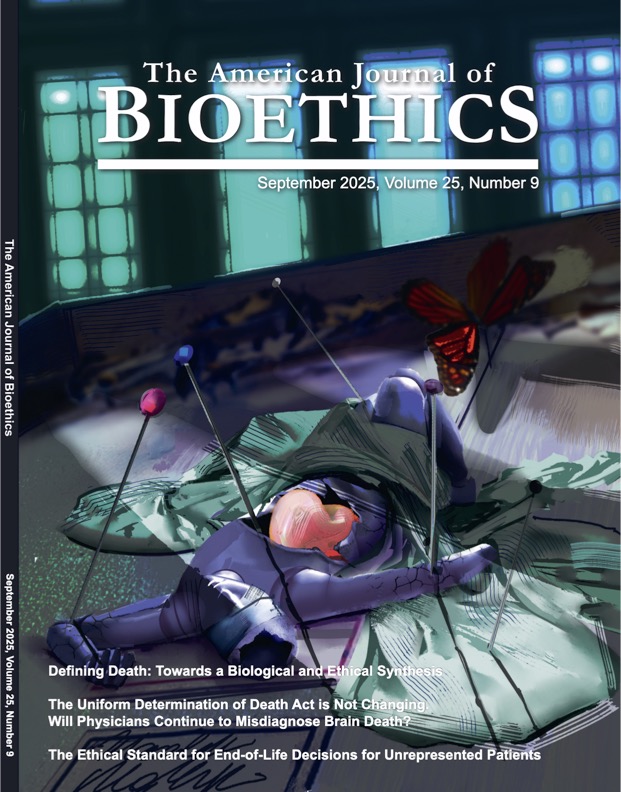
This editorial appears in the September 2025 issue of the American Journal of Bioethics
In the Spring of 2024 the Philosophical Bioethics Consortium, read Elizabeth Barnes’s wonderful 2023 book Health Problems: Philosophical Puzzles about the Nature of Health following her ground-breaking 2016 book, The Minority Body: A Theory of Disability. In Health Problems, Barnes writes that she started the book with a goal to get “clear” on what ‘health’ is, but ended with a sense of wonder, appreciating the complexities, tensions, and difficulties with coming to any unified definition, theory, or account of what ‘health’ is. Indeed, she writes, “I don’t know what health is. I don’t think that anyone does, or that anyone can”. Part of the problem lies with the fact that we want a theory of health to do many different things—to capture its biological importance, normative importance, political importance, and phenomenological importance. No one unified theory will do all these things, and Barnes brilliantly marches through each of the major families of theories (i.e., function-based, teleological, well-being based, phenomenological, social constructionist, and hybrid views) and shows why each is lacking in some way(s). Analytic philosophy at its best.
‘Death’ is like ‘health’ in this way, as the target articles in this issue reflect and as the field of bioethics has been slowly coming to admit over the last decade. When I began teaching bioethics fifteen years ago, the mantra that we taught our medical students and trainees was “brain death IS death” and there was little room for skepticism about the definition, concept, conception, or determination of death. The tides have changed and there is much more admission about the messiness of all these aspects of death. So much so that in 2021 the Uniform Law Commission undertook a multi-year effort to work to revise the Uniform Declaration of Death Act (UDDA). I was part of that process as an Observer on the committee and saw firsthand the challenge of finding a definition of death that could be agreed upon despite many hours of conversations and drafts from a well-intentioned and multi-disciplinary group of experts in bioethics, law, and medicine. The effort was abandoned in 2023.
Although unsatisfying, the failure of the committee to find or craft a clear account of the concept, conception, and determination of death is not surprising. This is because ‘death’ is like ‘health’. In both cases, what is needed is what Barnes, following Sally Haslinger, calls “ameliorative skepticism”. This is a philosophical concept that, to my knowledge, has not made its way into bioethics, but that is extremely relevant. To explicate it, I quote Barnes at length:
“…we might sometimes run into trouble because we’re caught in a cycle of trying to give a reductive analysis or necessary and sufficient conditions for something that just doesn’t admit of that kind of analysis…we’re theorizing something for which we need an account of that very thing as a unified whole…And yet there are intractable tensions, confusions, and inconsistencies for any unified explanation we might try to give. We thus find ourselves in a situation where we need to provide an illuminating answer to the “what is x?” question, and yet we can’t. It is this type of take on the “what is x?” question that I am calling ameliorative skepticism.
Ameliorative projects have at their core the idea that we need to change the way we think about the question “what is x?” and we need to do so partly in view of our (legitimate) political and social goals. What I’m arguing is that sometimes the best and most helpful change we can make is to understand that we face intractable dilemmas and confusions—dilemmas and confusions that won’t be solved by different, better, or more nuanced attempts at precision. They are, in a sense, baked into the very thing we’re trying to understand. Likewise, sometimes what counts as our “legitimate political and social goals”—the values that guide us and the work we need an understanding of health to help us do—can be conflicting and in tension precisely because of the nature of the subject matter. Understanding all this, I argue, can be helpful. It can explain why we feel pulled in so many different theoretical directions, why no answer seems satisfactory, why so much in the area is baffling. It can prevent us from going down unhelpful theoretical rabbit holes and from getting lost in patch-and-puncture cycles of debate.”
The lesson here is that there is likely no one “truth” about death that will be figured out and accepted by all or even most, just as there is no one truth about health—different understandings of these concepts unearth different metaphysical beliefs and different political, moral, and social goals.
Where do we go from here? Some might object that this sort of skepticism is not practical in areas where the law and medical practice needs concrete guidance (such as the definition and determination of death). They may also object that it is not “ameliorative” (positive or helpful) in any way, rather the opposite. I can see both downsides. Barnes’s take in the context of health is that such a skeptical position about finding “a definition” is simply unavoidable and intractable—it is just how things are regardless of how we might like them to be. And in her view, the skepticism is ameliorative in that it can help us explain why some questions are unanswerable (avoiding endless attempts to come to a clear and concise “answer”) and why some disputes feel intractable–-and it can point us to places where we might be able to make more progress. For example, in the context of death, it might point toward earlier and more open discussions on how to prioritize and balance various social and political considerations associated with different definitions and approaches to determination of death. It also points to more humility and less hubris and to more transparency and engagement with various stakeholders including the public, patients and families, clinicians, and key lawmakers on these issues.
In short, Barnes’s work on health has important insights for bioethicists working on death—but not just death. Indeed, many bioethical projects would benefit from the sort of ameliorative skeptical approach outlined by Barnes and Haslinger. Too often bioethicists try to develop “an account of” or “the definition of” fill in the blank (coercion, manipulation, suffering, undue influence, consent, capacity, autonomy, justice, personhood, health, disability). I too am guilty of this. But perhaps we would do well to abandon the search for “the theory” or “the account” in many of these cases, and instead engage in the sort of contextualism that Barnes advises—asking ourselves which definition or theory is most helpful given the context we are applying it to and given our goals and the work that we need the theory to do.
Jennifer Blumenthal-Barby, PhD