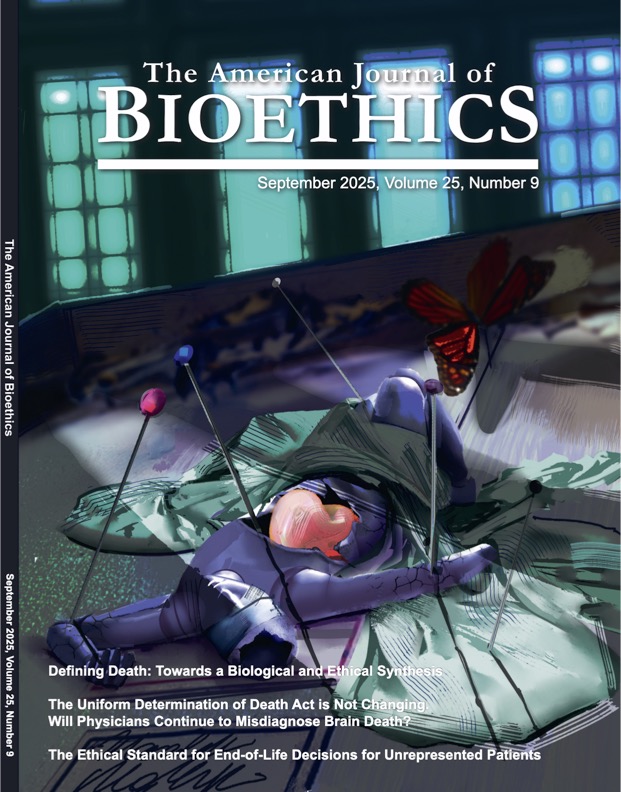
This editorial appears in the September 2025 issue of the American Journal of Bioethics
As much as humans yearn for definitive right answers and obvious distinctions between right and wrong, very little in life is black and white. Intolerance of uncertainty and need for cognitive closure often leads us to construct and then defend artificial certainty that is dangerous for many reasons. In the context of ongoing debates regarding the appropriate definition and accurate determination of brain death, the recent 2023 American Academy of Neurology (AAN) guidelines are a good example of this problem.
In this issue of the journal, two target articles offer stimulating considerations, from very different angles. John Lizza, Christos Lazaridis, and Piotr Nowak develop a social-civil conception of death that centers the capacity for conscious experience as a minimally necessary condition to having interests and thus being alive. Michael Nair-Collins argues that individuals with intact hypothalamic osmoregulation do not meet legal criteria for death as defined by the Uniform Determination of Death Act (UDDA), using physiologic details and logical analysis to question current practice. Whether one agrees with these authors or not, what makes both articles so valuable is their commitment to transparency, their willingness to acknowledge and engage with the biological and philosophical liminality of life and death and the intrinsically value-driven nature of defining the line that differentiates the two.
Lizza et al. argue that there is no value-neutral definition of a living organism—that there is always a choice involved about which functions are essential to that status. They explore a social and civil definition of death through comparison of “Guillotin”—a decapitated human body maintained on artificial respiratory and hemodynamic support—to a brain-dead body. Guillotin exemplifies the unavoidable interaction of value-driven decisions and biological phenomena in determining death in medical contexts, where medical technologies that can sustain breathing (mechanical ventilation) or circulation (CPR, ECMO) confound assessment of the organismal state of the body. Dropping any pretense of biological objectivity allows Lizza et al. to center the “pragmatic and value considerations” that are inextricable from death determination.
On the authors’ view, the capacity for consciousness is central to the ability to hold interests, and it is the permanent loss of the capacity to have interests that defines an individual as dead. Importantly, Lizza and colleagues are careful to distinguish their view from other “higher brain” definitions of brain death by emphasizing the necessity for epistemic and moral certainty about the permanent loss of consciousness, which is not achievable for individuals with permanent vegetative state/unresponsive wakefulness syndrome or minimally conscious state. In fact, certainty about permanent loss of the capacity for consciousness is so important to Lizza et al.’s argument that they recommend making documentation of cerebral circulatory arrest a requirement for the diagnosis of brain death.
In prior work, Michael Nair-Collins has agreed with Lizza about the value-laden nature of defining death, while arguing that a biological definition is still possible. Here, he examines what he calls a “mismatch” between the legal definition of brain death and standard medical guidelines and practice. A push to revise the UDDA in 2020 was suspended in 2023 due to lack of consensus, leaving the legal definition of death by neurologic criteria as “irreversible cessation of all functions of the entire brain, including the brainstem.” However, standard guidelines for diagnosing brain death, even after the 2023 revision, do not require assessment of hypothalamic function, and do not consider persistent hypothalamic osmoregulation to be inconsistent with brain death. For Nair-Collins, this means that up to half of patients declared dead by neurologic criteria do not actually meet the legal criteria for death. He addresses the most prevalent arguments for ignoring hypothalamic function, pointing out important biophysical and logical inconsistencies to make a compelling case that excluding hypothalamic function from determination of brain death is a deliberate choice based in pragmatic and value considerations, not in biological certainty.
The 2023 Consensus Guidelines for pediatric and adult brain death, codeveloped by the AAN, the American Academy of Pediatrics, the Child Neurology Society, and the Society of Critical Care Medicine, include a recommendation that “clinicians may initiate an evaluation and determine a patient brain dead/dead by neurologic criteria despite evidence of neuroendocrine function”. However, the rationale for this recommendation is entirely based on prior standard guidelines, which condense to an argument of “because we said so.” There is mention of the variable extracranial vascular supply that reduces the effect of ischemia to the hypothalamus and pituitary, which helps to explain why the hypothalamic-pituitary axis remains intact in a sizable percentage of patients who otherwise meet brain death criteria, but does nothing to explain why that function should not count when assessing for permanent loss of “all functions of the entire brain.”
These same consensus guidelines emphasize that ancillary tests such as cerebral perfusion studies should only be done when aspects of the clinical exam or apnea test cannot be completed or when the findings cannot be interpreted adequately. But why not require cerebral perfusion studies in patients with intact neuroendocrine function? The guidelines explicitly state that the process of determination must always begin with a presumption that the patient does not meet brain death criteria. They go on to detail numerous recommendations aimed at ensuring that there are no confounders to decrease the accuracy of the examination. This commitment to accuracy in the clinical exam stands in stark contrast to the quick dismissal of persistent hypothalamic osmoregulation and the guidance to avoid ancillary testing. Furthermore, the guidelines also recommend that “consent is not required to evaluate a patient for death” and that the timing of discontinuation of organ support and period of accommodation for families is the sole purview of the attending clinician of record and institutional policies. Taking this all together, the guidelines seem to be primarily concerned with reasserting epistemic privilege and authority by choosing to ignore contradicting information and declining to engage with alternate views of life, personhood, and moral status. But this approach risks worsening distrust with patient families and the public and compromising the integrity of medical professionals and clinical ethics consultants who may feel obligated to defend an incoherent (internally conflicted) account of brain death.
Both Lizza and Nair-Collins emphasize the need for greater transparency about the biologic uncertainty and value-driven choices that are inherent to current practice in determining brain death. Because of the definitive change in legal and civil status that accompanies a declaration of brain death, an inaccurate diagnosis unjustly denies that patient of their civil rights. Patients and their families therefore deserve rigorous intellectual honesty and epistemic humility from their clinical teams, professional organizations, neurocritical care experts and bioethics scholars alike. The distinction between life and death may never be black and white, especially as medical technology continues to progress. The grey areas—the uncertainties and inconsistencies, the mysteries we still can’t explain, and the values and beliefs that inevitably inform professional guidelines and ethical analyses—all matter. Lizza et al. and Nair-Collins invite us back into the grey.
Sabrina F. Derrington, MD