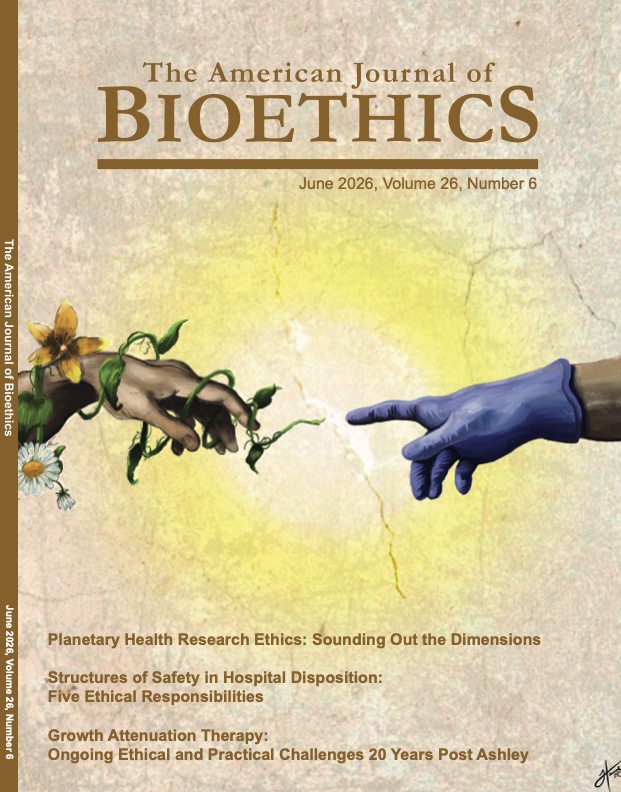
This editorial appears in the June Issue of the American Journal of Bioethics
Twenty years ago, Dan Gunther and I published our experience using high-dose estrogen to attenuate the growth of a young girl with severe and permanent neurodevelopmental disability that left her non-verbal, non-ambulatory, and completely dependent on others for her care. Gunther was Ashley’s endocrinologist, and I served as the primary ethics consultant on the case.
When Ashley began showing signs of puberty at six years of age, her parents asked her physicians to consider three interventions: growth attenuation with high-dose estrogen (GAT), hysterectomy, and breast bud removal. Keeping her smaller, they believed, would allow for longer, more personalized care in their home. Hysterectomy and breast bud removal were intended to reduce the potential burdens of puberty on their daughter. Their request reflected a thoughtful analysis of their daughter’s interests given her unique characteristics, her condition, her projected future, and available alternatives.
In the two decades that followed, the Ashley case became one of the most widely discussed—and contested—cases in pediatric bioethics, generating media and academic attention, criticism from some disability rights advocates and others, and legal and policy scrutiny. Revisiting the case offers an opportunity to reflect on what has changed, what has not, and what enduring lessons it offers for clinical ethics.
Lessons from the Initial Ethics Consultation
Expand the Working Group
While individual ethics consultation proves sufficient in most cases, novel or contested situations benefit from broader perspectives. The Ashley case presented three controversial requests, including two (GAT and breast bud removal) for which there was no published literature exploring the ethical issues. The ethics committee members who considered the request of Ashley’s parents included individuals from a range of disciplines and backgrounds, including a member who relied on a wheelchair and home-based lifts. The involvement of a broader group expanded expertise and made it more likely that assumptions and biases would be identified and challenged.
Examine Intuitions Carefully
Committee members initially had strong feelings about the requests being considered. These feelings required critical examination. Listening with openness and curiosity, seeking to understand alternative views, exploring the values and ethical principles at stake, deliberating thoughtfully, and critically evaluating arguments were all essential elements in trying to determine what would best serve Ashley.
Doing Nothing is Also a Decision
Much of the public criticism focused on the perceived harms of intervention. Yet nonintervention also carries physical, emotional, and relational consequences. Ethical analysis requires comparing the risks and benefits of both action and inaction, recognizing that both carry moral weight.
Frame and Organize the Ethical Questions Clearly
Any case involving multiple controversial and inter-related requests invites undisciplined discussion that roams from one issue to another. Our ethics committee discussion was enhanced by disaggregating the interventions—GAT, hysterectomy, and breast bud removal—and discussing the merits of each independently with the understanding that supporting one of the requests did not require supporting the others.
Respect Parental Authority within Limits
When reasonable people disagree about a child’s best interests, decision-making typically rests with parents, terrain that has subsequently been described as the zone of parental discretion.
Lessons from the Media Storm
The publication of our initial report generated a significant surge in media interest. The volume of media requests was overwhelming, with 500 calls from 154 media outlets within the first 32 hours. Protecting the family’s privacy and accurately representing their perspective became immediate priorities. The public response illustrated how quickly clinical ethics cases can become sites of broader social debate and raised questions about the role of ethics experts in commenting about specific cases.
Good Ethics Starts with Good Facts
Many people who commented on the case in the first several months did so without an accurate understanding of what had happened or why. In some cases, they ascribed unflattering motives to the family and clinical team that did not correspond to the facts on the ground. Patient privacy concerns and laws (and academic journal word counts!) limit the ability to share many of the specific details on which careful ethics analysis depends. Ethicists commenting on cases in which they were not involved should acknowledge uncertainty, avoid speculation, and distinguish informed analysis from opinion. In most cases, ethicists would be wise to limit their comments to the broader issues at play and avoid commenting on the specific case that may have triggered those discussions.
Avoid Reducing Complexity to Soundbites
Ethics experts speaking to reporters and writing commentaries for the general population have a responsibility to educate and clarify. The popular media loves a pithy soundbite, but soundbites cannot convey the complexity and nuance inherent in ethical issues. Referring to Ashley as “Peter Pan” (the girl who would never grow up) or as having been “frozen in time”, for example, grossly oversimplified a complicated case and misrepresented the intent of GAT, which was not to “infantilize” Ashley, but to improve her quality of life as she aged and matured.
Engage Criticism Thoughtfully and Learn from It
We catalogued over 30 distinct ethical objections to the care we had provided Ashley. Some raised legitimate concerns about the limits of medical intervention and the protection of vulnerable populations; others relied on incomplete facts, unsubstantiated claims, or flawed reasoning. Engaging these objections thoughtfully and transparently was an important part of our review process.
What Has Changed—and What Has Not
In our original report and subsequent publications we proposed several criteria for considering GAT in other children: the presence of profound and permanent cognitive disability, a near-certain prognosis after multiple independent evaluations, the strong likelihood that the patient will remain non-ambulatory, a provider and institution willing to provide and manage high dose estrogen, ethics committee review, and ongoing outcome review, ideally as part of a multi-center research study.
Determining how many children with cognitive disabilities have received GAT in the past twenty years has proved difficult, though available reports suggest at least several hundred. Public controversy and threats of legal action had a chilling effect on physicians and institutions inclined to offer GAT, driving the practice underground. While some institutions, including my own, have chosen not to offer GAT, others have done so quietly. The desire to remain outside of the public’s eye has had several unfortunate consequences. First, families struggle to identify willing providers and may lack the knowledge or resources to identify a willing physician, travel to that location, and carry out the treatment plan. As Brown et al. point out, this raises questions about equity. Second, eligibility and practice variability has been difficult to assess. Finally, the ability to study outcomes rigorously represents a lost opportunity to evaluate the benefits and burdens of GAT.
Finally, we had hoped that public discussion of the Ashley case would focus more attention on the limited social and financial support available to families caring for children with special needs. Instead, much of the early public debate focused on criticism of the clinical decisions made on behalf of Ashley, missing an opportunity to address these broader social and structural issues during the narrow window of media engagement.
Unresolved Ethical Questions
Several core ethical questions remain unresolved: how to balance respect for persons with profound cognitive disabilities and interventions that permanently alter their bodies; what constitutes benefit in cases where traditional markers of autonomy are absent; how to weigh the interests of caregivers, which are often deeply intertwined with those of the patient; what limits, if any, should be placed on parental authority in these cases. These questions resist simple answers and require continuing engagement with empirical evidence, ethical theory, and lived experience.
The Ashley case contributed to a broader conversation about disability, embodiment, and appropriate goals of medical intervention. Those conversations have been important, as has the inclusion individuals with disabilities in these discussions. At the same time, tensions persist between disability rights frameworks, which often reject medical models of disability and any attempts to alter the bodies of individuals like Ashley, and clinical frameworks that offer medical interventions when they appear capable of improving the well-being of individual patients. These tensions have not been resolved.
One additional issue warrants attention. Assessments of cognitive capacity rely heavily on expressive abilities. Individuals who cannot communicate preferences because of verbal and motor challenges may be presumed incapable of participating in decision-making, an assumption that may need to be revisited as new tools emerge to assess cognition independent of expressive abilities.
Tragic Choices and Moral Practice
The Ashley case involved a “tragic choice,” where no option was unambiguously right, and all choices involved some moral cost. In such cases, ethical practice is often not about finding a perfect solution, but about making the best possible decision under imperfect conditions. These situations call for humility to recognize the limits of our knowledge and fallibility of our judgments and courage to act in the face of uncertainty and criticism.
Ashley is now 28 and lives at home with her parents. They report that she is thriving and remain grateful that she is small enough to carry from place to place. While some individuals and groups strongly believe that Ashley was harmed, the people who know her best, her parents, believe that her interests were well-served.
Stanley Hauerwas has observed that living morally does not guarantee good outcomes. It does, however, call us to engage seriously with the responsibilities we bear to one another, especially the most vulnerable. The Ashley case continues to challenge us to think deeply about how best to do that.
Douglas S. Diekema, MD, MPH