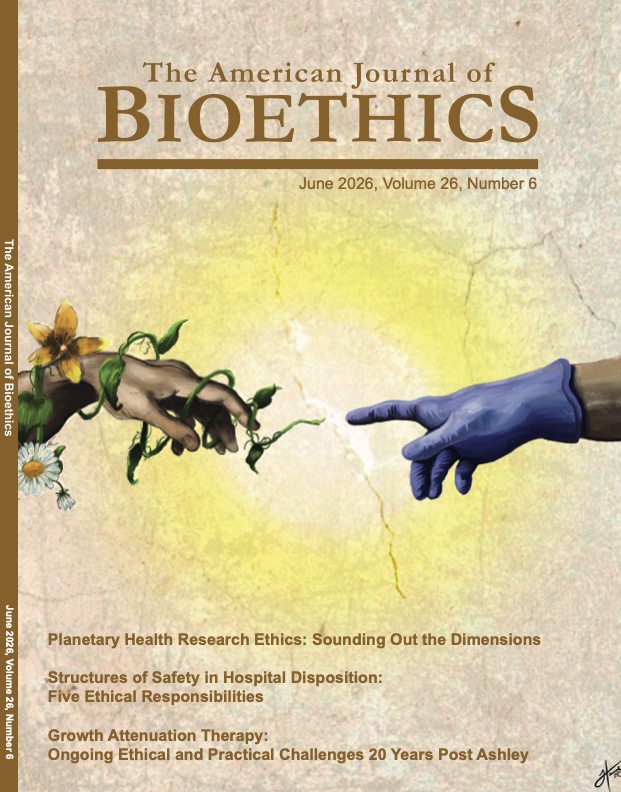
This editorial appears in the June Issue of the American Journal of Bioethics
Planetary ethics, or examining the moral relationship between humans and the physical world, is a growing field of inquiry related to the broader discipline of environmental ethics. Essentially, more people interested in the health of our planet and the negative impact humans have on it are asking questions about how we ought to relate to our planet, and whether and how we ought to alter our activities to protect our global home. In “Planetary Health Research Ethics: Sounding Out the Dimensions,” Sabine Salloch applies this ethical inquiry beyond the increasingly common conversation of how our current health care practices (i.e., disposable health care materials like gloves, gowns, masks, etc.) affect planetary health to research ethics. Salloch asks us to rethink the approaches, principles, and basic tenets of research ethics to protect our planet’s health in planet health research ethics.
Salloch offers three ethical dimensions of planetary health research ethics in their call to rethink research ethics in light of humans’ irreversible harm to the planet. The first two dimensions focus on mitigating harms. The third dimension draws on the issue of environmental injustice, or the idea that some people, namely those who contribute the least amount to unhealthy environments, are disproportionately affected by an unhealthy planet.
Despite this third ethical dimension, I argue that planetary health research ethics could be strengthened as an independent form of ethical inquiry and made more plausible as a new worthwhile bioethics endeavor if the principles used to establish its foundation explicitly acknowledge that our social lives and the social dynamics of our communities are an integral third party when considering the relationship between research and our planet’s health. Threading the reality of environmental injustice in our communities and concern for vulnerable populations throughout its foundation, for example, will make it more likely that its third dimension concerning environmental impact on human health will be taken seriously and not seen as an afterthought like many other new forms of bioethical inquiry.
Preliminary to the discussion of the proposed three dimensions of planetary health research ethics Salloch reviews what makes research valuable, namely the criteria that it has “social value.” Applying this criterion to planetary health research ethics, Salloch states that “planetary health research ethics needs to consider the health of the global population as embedded in complex natural environments and ecosystems that are profoundly altered by human activities and need to be protected”. One way to strengthen this argument, and give planetary health research ethics more grounding in the realities of our global world, is to explicitly acknowledge that the health of our global population is also dependent upon social environments, dynamics, and hierarchies that are created and maintained by human activities and behaviors. Social hierarchies, such as those created by power dynamics, politics, economics, structural discrimination and other social systems mediate individuals’ life chances and exposures to environmental harms, including how they recover from environmental harms. Our social lives and social dynamics also influence who benefits from research, who is involved in research, and who is harmed by research. As such, our social lives and the social systems that influence our lives are ethically relevant variables that must be central to the foundation of planetary health research ethics if environmental impact on human health is a mode of ethical inquiry that will be considered at some other point in the discussion of planetary health research ethics. If the ways that our social world influences research and environmental health is not weaved into the fabric of planetary health research ethics, it leaves itself susceptible to criticisms that both environmental ethics and research ethics, and bioethics as a whole, have been accused of, which is that it can be a form of elitism and prioritize individuals who are the most well off at the expense of the least well off. We are also seeing more of the realities of our social lives incorporated into our bioethical inquiries, especially those related to the ways that capitalist societies can harm natural environments and people’s health. Incorporating social dynamics and structural determinants of human health into the foundation of planetary health research ethics ensures that bioethical principles such as justice and respect for persons are meaningfully applied across diverse populations at every step of planetary health research ethics.
Building the additional ethical dimensions that explore the intersection between environmental protection and research ethics in dimension 1: practice of health research as a threat to the environment, Salloch explores the possibility of “conflicts between the goals of research and the protection of the environment”. But there is a third party in this conflict that is central to understanding the value of mitigating harm and who we are protecting the environment for and that is humans, particularly those who tend to suffer the most from unhealthy environments. Acknowledging that conflicts between research goals and protecting the environment can also conflict with protecting vulnerable humans would strengthen this ethical dimension of planetary health research ethics and make it align with common bioethical values.
For example, if researchers were to attempt to develop a new antibiotic to address a drug-resistant infection, the bulk of pharmaceutical waste would likely be created during the pre-clinical phase when researchers are creating different compounds and manufacturing processes. During this phase of research, it is possible that compounds and other wastes could be released into waterways affecting ground water in nearby communities, especially in places with less strict environmental regulations. Releasing waste into waterways can contribute to ecosystem disruption. According to planetary health research ethics, this research would be problematic because it is research that pollutes the environment and harms the planet’s overall health. I argue, that if we made environmental justice foundational to planetary health research ethics, then this research would also be problematic if we account for where pollution from research happens and who suffers the most. Since research that pollutes the environment often happens in communities populated with people made vulnerable by their low incomes, ethnicity, race, age, or geographical location, vulnerable populations could be unduly exposed to the waste from this research. These communities that rely on this now polluted water source for life’s daily activities could also have limited regulatory protections, little legal recourse for violations of their environmental rights, and face barriers to healthcare if adverse effects occur. Social ecosystems matter to the value of research and its impact on human lives and the environment. Research does not happen in a vacuum, nor does ecosystem disruption; there is always someone on the other side whose life is affected because of the ways our social societies are ordered, often with the most vulnerable people at the bottom.
Dimension three of planetary health research ethics—research considering the environmental impact on human health—states that planetary health research ethics aims to not worsen health inequities such as those created by environmental injustices, but to help facilitate research in a way that makes it responsive to the health care needs of people mostly affected by unhealthy environments. This ethical goal is absolutely necessary for this new take on research ethics and environmental ethics to have a place within bioethics, a discipline that values protecting vulnerable populations. But if the building blocks for this aim are not embedded throughout the foundational principles of planetary health research ethics, valuing equity, beneficence, and protecting people who are already disproportionately affected by unhealthy environments and poor research ethics can seem like an afterthought.
Planetary health research ethics has a chance to do what so many new theories and concepts in bioethics don’t, and that’s make health justice for the least well off and for the most vulnerable people in our local and global communities a priority, and not an idea relegated to the end of a paper or to the margins of its ethical inquiries. To do this, however, planetary health research ethics, at its core, has to concern itself with the realities of our social lives, including local and global power imbalances, the effect politics has on our lives, and inequitable resource distribution and the environmental injustices they create. Planetary health research ethics must also concern itself with past and present biomedical research injustices and their impact on the research community’s trustworthiness, particularly among marginalized populations like disabled people, economically poor, and racial and gender minorities. As planetary health research ethics merges both environmental ethics and research ethics, it also takes on both disciplines’ issues and relationship to the human population. Planetary health research ethics has to find its ethical footing within these longstanding ethical issues to be a valued discipline within bioethics. One way to do this is to rely on principles that can do some of this heavy lifting at every step of the ethical deliberations it proposes, namely principles that force us to consider the ways humans have organized the world and its effects on how we interact with our natural environments and research practices.
Keisha Ray, PhD