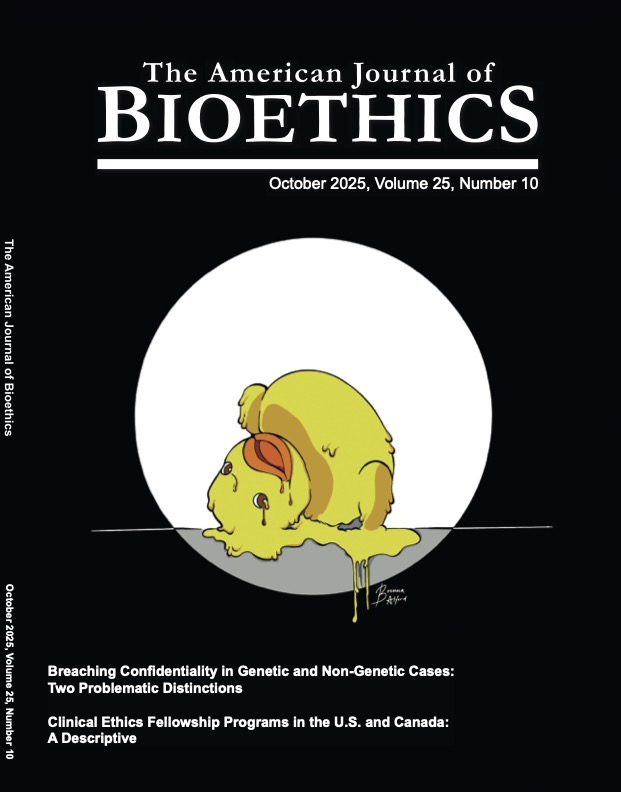
AJOB Volume 25, Issue 10
Related posts
Why High School Bioethics Education Is Important and How a High School Club Is Advancing It
High school students encounter bioethical questions everywhere: in science and health classes, with their increasing use of AI, when consuming genetically modified food, in family conversations about medical care. Engaging in bioethical discussions offers many benefits for these younger students, from better reasoning skills to critical thinking and decision-making. Political attacks on evidence-based science and […]
Ethics Consultants Do Different Jobs. Their Credentials Should Say So.
In a 2017–18 national survey, my colleagues and I found that 86% of U.S. general hospitals and nearly 98% of those with 500 beds or more had an ethics consultation service. The people who staff these services help patients, families, and clinicians work through difficult questions, such as whether to continue life-sustaining treatment when people […]
We Remembered Differently: The Atlanta Child Murders and the Ethics of Sleep
“We remembered.” These are two powerful words that show up in Tayari Jones’s reflections on Leaving Atlanta, her novel about Black children growing up during the Atlanta Child Murders of 1979–1981. Jones describes how the fear of those years remained with her long after childhood and resurfaced when a young boy she was tutoring failed […]
In Memoriam: The Sense and Sensibility of Dr. Jamie Lindemann Nelson
You can easily find Dr. Jamie Nelson’s decades of work and roughly 150 publications. What’s worth finding in them, and more valuable than the number of them, is the sense and sensibility with which that work, and Jamie’s life, was shot through. In 2009, I sat in Jamie Nelson’s office at Michigan State University, struggling […]